
The Great Purpose
Worship and Witness


1. The Question of Purpose: “Start with Why”
The business guru Simon Sinek has made a name for himself by calling organisations to ‘start with why’.
It’s a profoundly insightful question – and it’s worth asking about the church.
What is our purpose? Why do we exist?
Some might say that we exist to carry the beacon for a set of values, whether conservative or progressive. Don’t we always talk about morality?
Still others might say that we exist to provide a kind of spiritual therapy to the community – that we are a sort of wellbeing hub.
So—what is our ‘why’? Luke answers, but not as we expect: we exist to worship Jesus as Lord and to witness to him to the ends of the earth.
We gather to receive his blessing, but we are sent out by him to share his name.
2. The “End That Isn’t the End”
Luke finishes his gospel with the crowning of Jesus as the eternal king with his hands raised over his disciples in blessing.
And that might sound like the end of the story. It seems like a happily-ever-after moment. The tension of the original story has been resolved, its question answered: How does Mary’s child become the king? He is crucified and raised from the dead. What more do you need? That’s it. Job done.
But wait, says Luke, there’s more.
I told you the story of Jesus’ ascending once. But I need to tell you the story again, because there’s more to tell. The work of Jesus is only just beginning.
3. The Preparation: Resurrection + Kingdom + Waiting
Flip back to those days when Jesus was teaching the apostles, before he ascended. There was a forty-day intensive course for them, as we read in vs 3.
What was on the curriculum?
First, he proved to them many times over that he was alive. The resurrection of Jesus from the dead was not a concept or a theory but a reality. They needed to know it and believe it, because this was so vital to what they would be teaching others.
But he also spoke to them about ‘the Kingdom of God’, as we see in vs 3. It wasn’t just that he was alive. It was that he was alive as God’s king. God’s rule was now established in him – the place where the mighty are overthrown, and the humble poor are lifted high.
But then Luke tells us about one dinner when Jesus told them something truly extraordinary.
They aren’t given marching orders. He doesn’t give them a strategy or a set of KPIs.
They are told to sit tight in Jerusalem and wait.
What are they waiting for?
Wait for the gift my Father promised, which you have heard me speak about. For John baptised with water, but in a few days you will be baptised with the Holy Spirit.
The disciples know that this is huge – it is a truly epochal moment. The pouring out of the Spirit of God is a sign that the last days have come. The physical water of John would be replaced with a spiritual drenching from above.
It would mean not just the preparation for receiving the forgiveness of sins, but its reality. The Holy Spirit makes holy whatever it inhabits; so if this gift comes to the disciples, they will be made holy with God’s very own holiness. They will not just be physically washed; they will be spiritually cleansed.
Surely, that completes all the promises of God?
Roll credits.
You can see this in the question they ask in vs 6:
Lord, are you at this time going to restore the kingdom to Israel?
We can’t be too harsh on the apostles. Jesus himself taught us to pray ‘your kingdom come on earth as it is heaven’. Do we not long for an end to all the turmoil, suffering and struggle of human life? Are we not also ready for the promised rest and reassurance? Do we not also yearn for the finality of God’s kingdom?
But you do wonder at the apostles’ selective memory. It turns out that their hopes have been far too narrow and too nationalistic. What they’ve missed in the teaching of Jesus – and it was there in the Jewish Scriptures all along – is that the pattern of God’s salvation was always through Israel to the world.
The end of history cannot come yet, because there’s something yet to unfold. Jesus has died for the forgiveness of sins, risen from the dead, and ascended to his throne with his hands stretched forth in blessing. But he has been declared Lord over all of the creation. He has not just taken on Jewish but human flesh. And he dies not just for Jewish but for human sins. Now, he rises – Lord of all the earth and of all the peoples of the earth.
But if Jesus is Lord of all. How will the world hear it?
4. The True “Why”: Spirit-Empowered Witness
That’s what Jesus says to them next.
Forget about the timetable, he says to them in vs 6. That’s not for you to know.
But you will receive power when the Holy Spirit comes on you, and you will be my witnesses in Jerusalem and in all Judea and Samaria, and to the ends of the earth.
You will receive divine power for a holy purpose.
The Holy Spirit will not just cleanse them and unite them to God. The Holy Spirit will be the power of God himself in them – the power by which the world itself was made, the power that raised him from the dead.
The dynamic force of God himself will be given to them.
But what for? And this is where we return once again to the ‘why’. Why do they receive this extraordinary power?
Not for the conquest of the world. Not for building palaces and temples. Not for accumulating great wealth.
They receive this power so that they will be Jesus’ witnesses in an ever-expanding circle: in Jerusalem, then in Judea and Samaria, and to the ends of the earth. To the Jews, certainly; but also to the Samaritans, their estranged cousins; and then to the far-flung places of the earth. The declaration that Jesus, the crucified and risen Messiah, is Lord, will be carried with them to all the nations of the earth, so that every knee shall bow and every tongue confess the truth.
They are to be Jesus’ Spirit-empowered witnesses.
What is a witness?
A witness is one who speaks what is true—and stands by it.
I have stood in a courtroom as a witness. It is not a comfortable place to be. Under questioning, you learn quickly that you must hold to what you know to be true, and not go beyond it. Your words carry weight; your integrity is bound up with them.
The disciples are being called to be witnesses to the truth of what they’ve seen, to the ends of the earth: Jesus died for sins, according to the Scriptures, he was raised from the dead, and now reigns as Lord of all.
This is a truth that cannot be just my truth or your truth. As the missionary Leslie Newbigin once said: “The Gospel is public truth”.
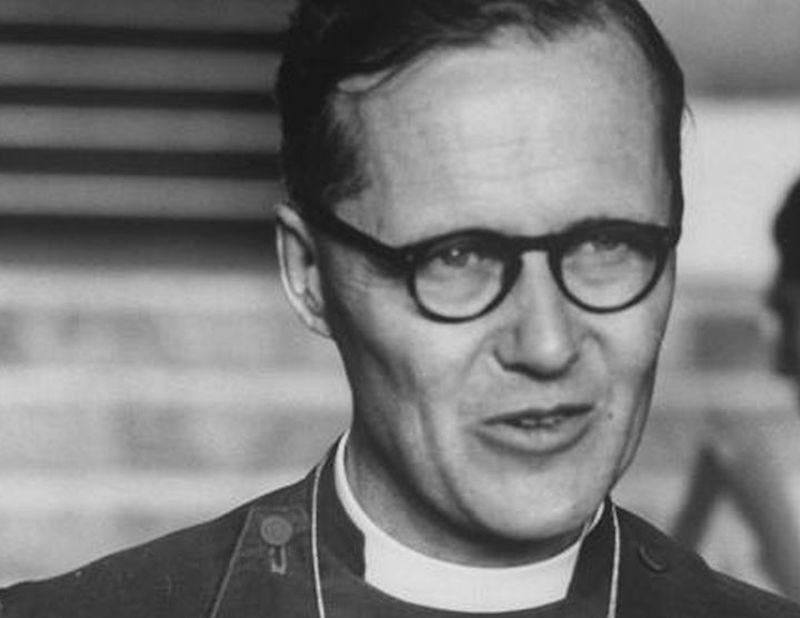
And this is not a task for a moment, but for a lifetime. They are to hold to this truth, and to speak it, wherever they are sent.
The word the New Testament uses is martus. It is a word that, in time, came to mean martyr. For some, this witness would demand everything.
Not all Christians will be martyrs who die for the truth about Christ. But all Christians are now called to testify to the same truth. Luke will show us how this begins in the book of Acts: in Jerusalem, in all Judea and Samaria, and to the ends of the earth. It won’t be a human task – it cannot have come from some strategy cooked up by the apostles. Rather, the power of the Spirit pushes them outward, further and further – even as far as Rome.
The disciples are clearly stunned as they watch Jesus taken up before their eyes, hidden from their sight—hands still stretched out in blessing, but now also sending them into the world.
And they just stand there.
You can picture it: twelve men, heads tilted back, mouths slightly open… like a row of sideshow clowns.
What are they waiting for?
Which is when the two angels have to appear and say: “What are you looking in the sky for?” This isn’t a spectator sport. You’ve got a job to do!
You’ve got your why.
5. Blessed and sent
So here is our identity, and our purpose.
We are Jesus’ blessed disciples. That is our “who”. And from who we are comes a powerful “why”. As his blessed disciples, Jesus sends us out into the world to be his witnesses – to the ends of the earth.
There’s no corner of the earth that is not his. And no part of our lives into which we are not called to bear witness.
You might say that here in Australia, we are already at the end of the earth! But our workplaces, our homes, our schools, our friendships – these are the ends of the earth in which we are called to testify that Jesus is Lord – by what we say, and by how we live.
We exist to worship Jesus and to witness to him. Or as Peter puts it: to declare the praise of him who called you out of darkness into his wonderful light.
This is a grand and exciting purpose! But I know many of you feel daunted by it. What if I say the wrong thing, or come across as a fanatic? Witness is simply ordinary, daily truth-telling that works best when we speak of Jesus naturally and relationally. It’s powerful when it comes out of our genuine care for people.
Not all – or any – of us are called to be martyrs. But we are all called to be truth-bearers for the name of Christ.
And we have an X factor. We do not generate this ourselves. We receive power from above to make us bold to speak! The spread of the gospel is not a programme carried out by human strength. It is God’s mission, powered by the Holy Spirit, who guides us in what to say and gives us courage when we are timid.
So, this week: get in touch with God’s purpose by praying for one person you can witness to. Pray for an opportunity with them. And pray for boldness to invite them – to church, to Hope Explored, or even just into a conversation about Christ.
Jesus still stands with hands over you in blessing. But those hands now also send you out. The blessing you have received becomes the message you carry. We worship him, and we witness to him, so that others will know that the risen Jesus is Lord.
Great! 3 questions though: is the Holy Spirit ‘it’ and were there 12 or 11 when Jesus sent the apostles out?